
South Coast Flame FC was formed in 2017, the Club’s vision and philosophy when we first began was to provide our Association players and coaches with a representative pathway that was focused on local player and coaching development.
Over the 9 years the Club has been operating, we are now starting to see the realisation of that vision and philosophy we set out to achieve. Not only have we seen success in the player pathway, with many players developing through the Club but are also seeing the realisation of this in our coaching staff.
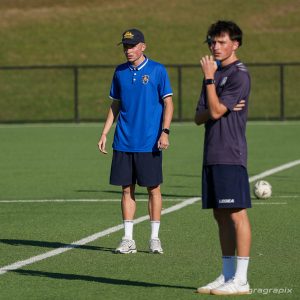
With our spotlight on MJDL, Youth Boys and Men’s programs, we caught up with Sam and Zander Alston, two young coaches, given an opportunity within our club to progress and develop.
We started by finding out about why they started coaching and whether there was someone or something that provided the inspiration for them to pursue coaching.
Sam: I started out as a coach at the Football South Coast holiday clinics as a 16 year old, under the guidance of Jonathan Forster. I have great memories of being a little primary school kid and attending the clinics myself!
Zander: Like a lot of players growing up, I always thought coaching was something I’d like to do one day, probably after I finished playing. It definitely happened a lot sooner than I expected, and I haven’t looked back since.
My grandfather has always been one of my biggest inspirations in football. He had a successful career as both a player and a coach, and seeing the impact he had on those around him definitely influenced my passion for coaching.
Sometimes it’s not just one thing that can inspire you to branch out, sometimes it just happens without you even realising and all of a sudden, you are in the moment, enjoying the new challenge. For others, there’s a clear defining point that stands out as a moment where you make a decision and know it’s been the right one. It’s fantastic that you had an opportunity to move into coaching at such a young age, tell us about your progression as a Flame coach – where, why and when did you start?
Zander: Sam and I first got involved with Football South Coast through the holiday clinics and academies, where we spent a couple of years coaching. From there, Jonathan Forster, who was one of our first coaches when we were younger, approached us about joining the SAP/JDL program, and that’s where the journey really began.
My first coaching role was as the assistant coach of the U11 SAP team in 2023, working alongside Carlo Stella. I remained as assistant coach when that group became U12 the following season before stepping into the head coach role with the U13s with Sam, and this year, Sam and I are coaching the U14s together, and I’m also the head coach of the U12 MJDL team alongside Ryan Carr.
Sam: My first coaching appointment was in 2023, where I was an assistant in the SAP program. I served as an assistant for a couple seasons working with Ryan Chard and Anthony Oliver. And in 2025, Zander and I took on the U13s role together and we are still with them now in the U14s. I also still coach the same group of JDL kids, the U11s, who Anthony and I have had since they were in the U9s.
It seems that the FSC Holiday clinics were a great place for you to both start your coaching journey, being able to work with other coaches and gaining valuable knowledge to lead you into representative coaching. Having experienced coaches to work with in the representative space, seems to have been key to your progress into head coaching roles. How has Flame supported you as coaches?
Sam: Flame has supported me as a coach by giving me the opportunity to coach in the first place, which has been invaluable for my development. Being trusted with a team has allowed me to build confidence and gain real experience in planning and delivering training sessions.
Beyond that, the community at the Flame has been pivotal in the way I feel supported. The workshops the club puts on, the guidance from all the coaches and technical directors I know, has really supported me and helped me develop. The parents of all the players, not only the ones I coach, have been awesome too. Saturday is the best day of the week, I have great relationships with so many different families across all age groups, so that helps with my enjoyment.
Zander: We’ve been incredibly fortunate to be given opportunities at a young age by people like Jonathan Forster, Matt Borg, Richard Lloyd, and now Neil Mineeff, along with the support of the club and the board as a whole. They’ve all played a big part in my development as a coach.
One of the biggest strengths of Flame is the number of experienced people involved. As both a player and now a coach, I’ve been able to learn from a wide range of coaches and players, each with different ideas, experiences and perspectives. Being exposed to that has helped shape my style and processes.
The club has also been fantastic in providing opportunities to continue developing through coaching courses, workshops and ongoing education.
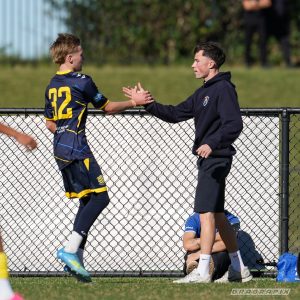
You’ve highlighted a variety of different influences and mechanisms of support, which have certainly given you both a broad range of ideas, concepts and coaching styles that you can use as a platform to develop yourselves into the type of coaches that you would like to be. The support of experienced coaches and development opportunities, as you’ve mentioned, has given you confidence and a pathway to your own coaching style. Now that you are on that pathway, what would you class as your biggest achievement to date, on a personal level and collectively with any of the squads you have coached to date?
Zander: I’m still in the early stages of my coaching journey, so I wouldn’t say there is a personal achievement. But, to be honest, I don’t really see coaching as being about me, it’s about the players and helping them be better every day.
However, what I’m most proud of is the progress both Sam and I have made with our current U14 squad. One of the most pleasing things has been the continuity within the group, with very little turnover from year to year. That consistency has allowed us to build strong relationships and culture within the group, but also build on things football wise. It’s been really rewarding for me personally to see the improvement, not just in our performance metrics compared to last season, but also in the way the team plays, the football understanding of the players, and their growth as young people. More than half of the current squad were part of the U11 team when I first started coaching, so it’s been a privilege to watch them develop over the past few years. Seeing them grow in confidence, ability and character has been far more rewarding than any result or trophy.
I can imagine that working with players in the JDL space and then coaching them into the youth space, would surely provide you both with a sense of achievement as coaches, seeing those players grow and develop as footballers and in general, as confident young people. It must be great to see that progress and know that you have had a hand in shaping that player. In saying that, you are both coaching in the JDL space and the youth space, turning your focus to the youth space, how do you plan for game day? Do you have a different game plan for each opposition that you face?
Sam: I think it’s important on game day that the routine stays the same, so every game day, our run sheet and routine is always the exact same. I think this helps the players feel settled and get switched on. During the week, we have resources such as the Veo Footage and our presentation, which we show every Monday. In the presentation, we use clips we can learn from and hopefully find information on the other team which can help too. In terms of match plans, they can differ every week depending on the training cycle, opposition we are against, or even the field we are playing on.
Zander: Every week is different, but one thing we keep consistent is our routine. We believe that having a clear process each week helps prepare the players both mentally and tactically.
With the U14s, every Monday night after our on-field session we do a video review using the VEO footage. We reflect on the previous weekend’s performance and also look at the week ahead by analysing our upcoming opposition and potentially talking about the tactical things we may want to implement or tweak.
Building this routine and making it a consistent part of our weekly program has been one of the biggest positives this season.
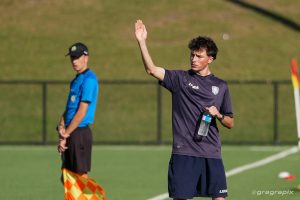
So providing consistency and routine seems to be the key focus. Your presentations sound like they are very helpful in reflexion for your squad and in preparation for the next game. Coaching is not just about the session we see on the field on training nights or the guidance you provide on game day, there is so much more behind the scenes before you even get to the ground, to provide the consistency, routine and preparation you want for your team. Even though you are working with a team are you conscious of each players differences, needs, skills, ability, understanding of the game etc and how do you work those individual needs into a training session/game day?
Sam: I think the first thing I try to do is to make training an environment where everyone wants to come to and wants to be at, because I think you see your best days of development when training is enjoyable.
Then to work on those needs, in training and games, I think you need to understand your players more personally. I think we understand that everyone learns and deals with things differently, for example, some players love a bit of a rev up and love to be pushed, where some may need an arm around the shoulder.
Zander: Absolutely. While we’re coaching a team, we never lose sight of the fact that every player is different. Each player learns differently, has different strengths and areas for improvement, and responds to different coaching methods.
Sam and I are different as coaches too, and we feel that’s one of our biggest strengths. We balance each other well, which allows us to connect with different players in different ways. We understand that what works for one player might not work for another, so we try to change our communication, feedback and support to the individual where we can.
Our aim is to create an environment where every player feels valued, supported and challenged. If we can understand what each player needs to perform at their best, we’re giving them the best opportunity to develop while still contributing to the team as a whole.
Considering and working on development of individual player needs, shows more of the work behind the scenes to ensure that you are providing the best environment possible for players to learn and grow and is an essential part of your coaching. Again, it’s not just the package that we see from you both during a training session and/or game day.
There are so many factors that you need to work on with and for your team, above all of these, you are also in a situation where your team is playing to achieve results. What techniques do you use to motivate your team and/or keep them focused if a result hasn’t gone the way you had planned?
Zander: Football is unpredictable, and there are always games that don’t go the way you planned/want it to.
During those moments, Sam and I always remind our players back to our three core values: Positivity, Effort, and Togetherness.
We believe that if every individual takes responsibility for those three things, the football will usually take care of itself. There’s never an excuse to be negative, there’s never an excuse not to give 100% effort and there’s never an excuse not to compete and work for your teammates. Those are all things that are completely within our control.
We constantly remind the boys that effort will always give you the best chance of getting over the line. You can’t control everything that happens on that field, but you can always control your attitude, your work rate, and how much you’re willing to compete for the team.
We both feel that this is reflected in our squad so its pleasing on our behalf.
These are certainly great values to instil in your players and I’m sure as players yourselves, these are values you use in your own games. Being a player and a coach, must be a challenge to wear different hats, how do you juggle these two roles? Switching from coach mode to player mode, or is this something that goes hand in hand and you don’t really switch off from either?
Zander: I wouldn’t necessarily say I switch off from either role, but whatever I’m doing at the time has my full focus. When I’m coaching, all of my attention is on helping the players and giving them everything they need to perform. When I’m playing, my focus shifts completely to doing my job for the team as a player.
Sam: The main priority at the moment is playing, which comes first before coaching. So any clashes in the schedule, that comes first. But in terms of juggling these roles, I think it comes hand in hand at times. There’s so many different things I’ve picked up on as a player that I use in my coaching, and vice versa.
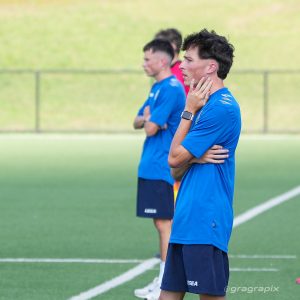
Playing and coaching seem to go hand in hand for you both. By remaining in a competitive playing environment enables you to provide real time situations for your players when you are coaching. On the other hand, being a coach allows you to see the game from a different perspective, which seems to contribute to the way you play and assist in decisions that you are making on the field, as a player. Coaching and playing doesn’t seem to distract one from the other for either of you, you’re as focused on the task when you are playing as you are when coaching.
Along your coaching pathway, you mentioned earlier, a number of influences that have been a part of journey, what’s the best piece of advise that you have received as a coach and who gave it to you?
Sam: It’s hard to sum up just one piece of advice because I have learnt and taken on so much from many different Technical Directors, coaches and players I’ve been lucky enough to play and coach with. Something that has always stuck with me from a young age is something that Matt Borg and Stan Pappas would always say and it was to have faith in the process and always back yourself. There are many challenges in life that influence football where you aren’t going to be at your best, feeling your best and you’re low on confidence, And I’ve had these days as a player myself, but it’s important to back yourself first of all, and just trust the process / journey you are on because the hard days mould you into the person you end up becoming. This is something I’ve tried to pass on to the players that I’ve been coaching the past couple years.
Zander: There are two things that have really stuck with me, both from Matt Borg and Richard Lloyd.
The first was from Matt Borg on the day I made my first-grade debut. He told me that ‘development is like a roller coaster, there are highs, there are lows, and it’s unpredictable. Everyone develops at a different pace, so the only thing you can control is your own effort and commitment at every training session and every game’. That’s something I’ve definitely tried to carry into my coaching, and something I always tell players and parents.
The second was from Richard Lloyd, who always reminded us to ‘try to keep things as positive as possible’. He believed that when players feel supported and positive, their effort and their buy-in to you will naturally follow. That has definitely become a big part of my coaching philosophy and the environment Sam and I try to create for our teams.
Some solid advice and some experiences of your own that you are able to draw on and use effectively in your coaching roles now. If you had to give advice to someone wanting to become a coach, what would it be?
Zander: Take inspiration from every coach you work with or learn from. Take those parts you like or think they do well and over time, combine those ideas and shape them into your own ways.
Sam: The best days in coaching get shown in progression over time.
Great pieces of advice!
We hope that other coaches and players who are reading through your journey, are inspired by your focus, your determination and your willingness to continue to learn and grow yourselves. There is more to coaching than being out on the field running training sessions and guiding your squads on the weekend. You are both doing an amazing job and we look forward to seeing where your coaching journey takes you.
Comments are closed.