
From the Furnace to FIFA: How the South Coast Flame and UOW Are Helping Shape Women’s Football
Female Football Week provides an opportunity to celebrate not only the growth of the women’s game, but also the people, partnerships, and innovation helping shape its future. Over the past three-and-a-half years, the partnership between the South Coast Flame and the University of Wollongong has evolved into a unique collaboration that integrates player welfare, sports science, research, and student development within women’s football.
Built around a genuine “win-win” philosophy, the partnership has been designed to sustainably support the club while also creating meaningful educational and research opportunities for students and staff from UOW’s Exercise & Sports Science discipline.
A key component of the program is the placement workforce embedded across the Flame pathways. Around 15 UOW Exercise & Sports Science students currently support the players and coaching staff in areas such as injury prevention, athletic development, recovery, and load management. Importantly, the students, technology, and monitoring infrastructure are all provided through the University partnership, allowing the club to access expertise and resources that are rarely available within women’s football environments.
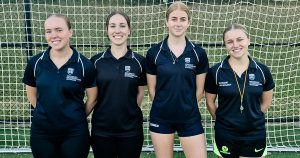
The students work under the guidance of experienced practitioners connected to the program, including staff from Figtree Physiotherapy and the Flame’s strength and conditioning team. In many ways, the partnership reflects the strength of the local football and academic community, with many of those involved — including coaches, physiotherapists, researchers, and performance staff — either currently undertaking, or having completed, PhD research through UOW.
Beyond the practical support provided to the club each week, the partnership has also become a platform for internationally recognised research with substantial real-world impact.
Using advanced wearable technology embedded seamlessly into training and warm-ups, Flame players have contributed to projects examining player fitness, fatigue, movement quality, training responses, female health, and performance in women’s football. The work has helped develop more practical and player-centred approaches to monitoring athletes, while ensuring the collection methods remain minimally invasive and sustainable within a community football environment.
Research emerging from the partnership has now been published internationally, featured alongside leading professional clubs in global sports science reviews, and incorporated into education programs delivered through FIFA to practitioners working in women’s international football around the world. The projects have also helped inform the development of athlete monitoring technologies and software now used more broadly across the sport.
Importantly, the benefits of the collaboration extend directly back to the players. Through the partnership, Flame athletes have gained access to advanced laboratory testing, wearable technologies, performance monitoring, and evidence-informed training practices that are rarely available to most women’s football teams, even within many professional environments globally.
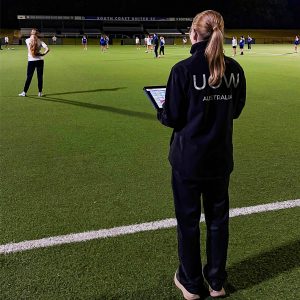
The success of the program has been driven by a collective commitment from across the football and university communities. The club and the University acknowledge the important contributions of the Women’s Coaching Team (Daniel Naumovski, Brad Moreira & Ryan Trevor) as well as Dr Matt Whalan, Dr Stella Veith, Lachlan Mackenzie, and the broader coaching and medical staff, the players, students, and the Flame board for their continued support of a partnership built around innovation, education, and player welfare.
As women’s football continues to grow rapidly in Australia and around the world, the partnership between the Flame and UOW highlights what can be achieved when community clubs and universities work together with a shared purpose — supporting not only the current generation of players, but also helping shape the future of the women’s game.
Ric Lovell
Professor & Discipline Lead – Exercise, Sports Science & Rehabilitation
School of Medical, Indigenous and Health Sciences | Faculty of Science, Medicine and Health | 41-335
University of Wollongong NSW 2522 Australia
Comments are closed.